
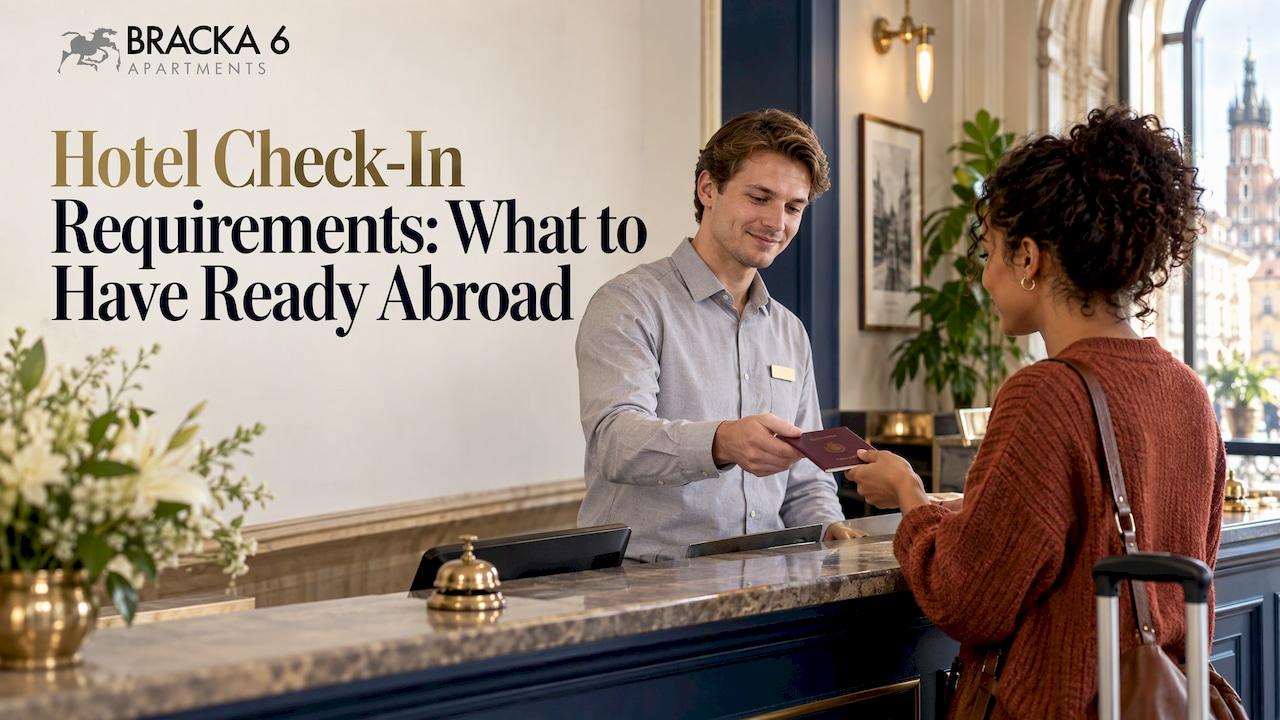
To check in at a hotel abroad you need four things: your booking confirmation, a valid passport or other photo ID for the person who booked, a payment card in the booker's name, and an arrival time the property knows about. Everything else is detail. That detail changes by country, by type of accommodation and by whether you arrive at 2pm or after midnight. This guide covers what to carry, what reception may ask for, what happens to your ID, and how it works for a city break in Kraków. If you are staying in boutique apartments in a 15th-century townhouse, 100 m from Kraków's Main Square, such as Bracka 6, the same checklist applies.
TL;DR
- Carry your passport (or national ID card where valid for travel), your booking reference and the payment card used for the booking.
- Expect a card hold or deposit for incidentals at many hotels: it is an authorisation, not a charge, but it can reduce your available balance for days.
- Rules on copying or keeping ID differ between countries. Reception may note your details or copy them, depending on local law.
- Tell the property your arrival time in advance, especially for flights landing in the evening or at night.
- Read the stay terms before you travel, so nothing at the desk is a surprise.
Table of Contents
- The short checklist before you leave home
- Identification: what you will be asked to show
- Payment: the card, the hold and the deposit
- Check-in times, early arrivals and late arrivals
- Digital check-in and sending details in advance
- Age, groups and who can book
- Check-in requirements for a Kraków city break
- A worked example: arriving from London on an evening flight
- Our view from the front desk
- Staying in Kraków's Old Town
- FAQ
- Sources
The short checklist before you leave home
Before you leave, put these in one place, ideally your phone and a printed copy of the first one:
- Booking confirmation. The email, reference number or QR code. Many hotels will find you by name, but a reference speeds everything up.
- Photo ID for every adult. For a British, American or Australian traveller in Poland, that means a passport.
- The payment card used for booking. If someone else or a company is paying, bring their written authorisation if the property asks for it.
- Your arrival details. Flight or train number, and a realistic time.
- Contact details for the property. A phone number or messaging app, in case your flight is delayed.
That is the whole list. The sections below explain why each item matters and where things go wrong.
Identification: what you will be asked to show
Hotels almost everywhere ask to see an identity document when you check in. A step-by-step check-in guide lists identification required by the property as one of the standard items to have ready, alongside your confirmation and payment method. When you are abroad, that document is normally your passport.
For travellers from the UK, the passport itself needs to be in order before you even reach the hotel. GOV.UK's Poland travel advice explains that Poland follows Schengen rules: your passport must have been issued less than 10 years before the day you arrive, and must have an expiry date at least three months after the day you plan to leave the Schengen area. Check both dates now. A passport that is fine for the hotel desk can still be refused at the border. Travellers from other countries should check the entry rules of their own government and Poland's.

Does every guest need to show ID?
There is no single global rule. In practice the person who made the booking is always asked, and in many countries the law requires details of all guests to be recorded. If you are travelling as a family or a group, keep every adult's passport accessible rather than packed at the bottom of a bag. Children are usually recorded by name and date of birth rather than by document, but the property will tell you what it needs.
Can the hotel copy or keep your passport?
This is the question travellers worry about most, and the answer depends on the country.
- In the EEA, data protection law applies. The Dutch data protection authority explains that copying an identity document is permitted only when necessary, for example to meet a legal obligation. It also notes that you can ask the accommodation why a copy is needed, because staff may agree to simply note down certain data instead.
- Spain's consumer ministry takes the same data-minimisation view: a full passport or ID copy holds more information than the traveller register needs, so keeping one can be a breach even where showing the document is required.
- Outside Europe the picture differs. New Zealand's Privacy Commissioner says a hotel may copy your passport or driving licence, but only temporarily, and that there is usually no reason to keep the copy once your identity is confirmed.
The practical rule is the same everywhere. Hand over your passport to be checked and registered, take it back at the desk, and do not leave it overnight as a matter of course. If a copy is made, it is reasonable to ask politely what it is for and how long it is kept.
Payment: the card, the hold and the deposit
Most hotel disputes at check-in are about money, not documents. Three things are worth knowing.
Many hotels want a card on file. NerdWallet explains that most major hotel brands require a credit or debit card on file to cover cancellation fees and incidentals, and that many hotels will not let you check in without a card for the deposit. Even if you have prepaid, bring a card.
A hold is not a charge. An authorisation hold is an amount set aside on your card for possible extras. It is released after checkout, though releasing it can take several days. A hold on a debit card ties up real money in your account, which is why a credit card is often the more comfortable choice for this. If you travel on a prepaid or debit card, check your available balance before you arrive.
The name on the card should match the booking. If a company, a parent or a friend paid for your stay, tell the property before you travel. Some will ask for a written authorisation from the card holder, and sorting that out by email is far easier than at a desk after a long journey.
For stays in Poland, remember that the local currency is the złoty. If you are offered the choice at a card terminal between paying in złoty or in your home currency, ask which you are being offered before you tap.
Check-in times, early arrivals and late arrivals
Check-in windows vary by property. General guides put the usual window in the afternoon, roughly between 2pm and 4pm, and recommend calling ahead if you hope to arrive early or expect to arrive very late. The exact time for your stay is in your confirmation, so read it rather than assuming.
A few situations come up again and again for city-break travellers:
- Morning flight arrivals. You may land in Kraków at 10am and find your room is not ready. Ask whether luggage can be stored, then use the morning: the Old Town is compact and walkable from the station and a short ride from the airport.
- Late evening or night arrivals. Send your estimated arrival time in advance, and update it if your flight is delayed. Properties without a 24-hour desk may need to arrange access for you.
- Early departures. If you leave before the breakfast service begins, ask about alternatives. Some properties offer packed meals for early starts.
If you want more time on the day you leave, our guide to late check-out in Poland covers how to ask and what to plan.
Digital check-in and sending details in advance
More properties now let you submit your details before you arrive, either through an app, a link in your confirmation email or a form. Where that is offered, it shortens the desk process to a document check and a key. A guide to the hotel check-in workflow shows how app-based options and advance documents fit into the process from the hotel's side. For you, the habit is simple: if your confirmation includes a pre-arrival link, complete it on the plane or the night before, with your passport open next to you so names match exactly.
If your booking offers mobile check-in or a digital key, download the app before you travel and log in on Wi-Fi, not on roaming data at the door.

Age, groups and who can book
Minimum-age rules differ between countries and between properties, and there is no universal figure. If anyone in your party is under 18, or if the person booking is not the person arriving, say so when you book and confirm what the property needs. The same applies to groups: a booking for four guests should name the guests who will stay, and everyone's details may be recorded.
The stay terms are where these rules are written down. Properties publish them for a reason, and reading them before you pay takes five minutes. Ours are in the Bracka 6 booking terms.
Check-in requirements for a Kraków city break
Poland is in the Schengen area, so your documents are checked twice: once at the border or airport, and again at the accommodation. In practice, what matters on the Kraków side is straightforward:
- Bring your passport, not a photocopy or a photo on your phone. A scan will not replace the original at the desk.
- Keep the booking details accessible offline, in case your phone has no signal after landing.
- Know your route. Kraków's Old Town centre is largely pedestrianised, and cars are restricted in much of it, so a taxi or transfer may drop you a short walk from the door. Luggage with wheels copes well with the historic cobbles, but allow a few extra minutes.
- Plan the cancellation side too. If your plans might change, check the flexibility of the rate before you pay. Our guide to hotel cancellation policies in Poland explains what to look for.
Be aware that rules on guest registration can change, and that practice differs from one property to another. The honest answer to "what will they ask for?" is always the same: your passport, your booking and a card, with the property's own terms filling in the rest.
A worked example: arriving from London on an evening flight
Imagine two travellers booking a three-night stay for a weekend. Their flight lands at 8.40pm, and with passport control and bags they expect to reach the Old Town around 10.30pm.
- A week before, they check passport issue and expiry dates against the Schengen rule on GOV.UK.
- Two days before, they email the property with their flight number and an estimated arrival of 10.30pm, and ask how late arrivals are handled.
- On the day, they save the confirmation to their phones and take a screenshot, so it opens without signal.
- At the desk, they show both passports, confirm the names match the booking, and present the card used to book.
- They ask politely whether a copy of their passports is being kept and why, and take the documents back.
Nothing here is complicated. It is a ten-minute preparation that removes the usual friction.
Our view from the front desk
We run boutique apartments in a 15th-century townhouse, and we think a good arrival starts before the guest reaches the door.
Most of the stress at check-in comes from small unknowns: where do I go, what do I need, what time can I arrive? That is why we encourage guests to read our booking terms in advance and to tell us their expected arrival time. If you are flying into Kraków-Balice or arriving at Kraków Główny station, we offer transfers, so you do not have to work out the route to the Old Town at the end of a long journey.
Our apartments are for two to four guests, so we think of arrivals in terms of couples and families rather than crowds. Each apartment has its own kitchen area, air conditioning, free Wi-Fi and private bathroom, which means you can settle in properly after the desk formalities. If you are leaving early for a train or a flight, we can prepare a packed lunch, and breakfast is served at Sempre Bracka, our on-site restaurant.
Bring your passport, your booking and your card. We will take care of the rest.
Antek
Staying in Kraków's Old Town
If your plan is a stay close to the Main Market Square, Bracka 6 offers four types of apartment, Studio Superior, Studio Deluxe, Studio Executive and Apartament, in a historic townhouse 100 m from the square. Each is fully equipped for two to four guests, with daily cleaning, and breakfast is available in the on-site restaurant. You can see the options and book on the Bracka 6 website.

When you book direct, you see the terms for your apartment before you pay, which makes the check-in questions above easier to settle in advance.
FAQ
Can I check in to a hotel without a passport?
In most countries, not if you are a foreign visitor. Hotels ask for a passport or other valid travel document to register guests, and you are also required to carry it when travelling abroad. Check the entry rules for your nationality, and bring the original document, not a copy.
Do I need a credit card to check in?
Many hotels ask for a card to cover incidentals or a deposit, and some will not check you in without one. A credit card is usually the smoother option, because the hold on a debit card reduces the money actually in your account. If you have no card, ask the property in advance what alternatives it accepts.
Can a hotel keep my passport overnight?
It should not be a routine. Under European data protection rules, copying or holding an ID is limited to what is necessary, and you can ask why it is needed. If your passport is taken for registration, ask for it back at the desk once the details are recorded.
What if I arrive very late or very early?
Tell the property your expected arrival time before you travel. Early arrivals may be able to leave luggage, while a room is only guaranteed from the stated check-in time. For very late arrivals, advance notice allows the property to arrange access.
Does a booking made through a third-party platform change what I need?
The documents are the same: booking confirmation, passport and payment card. What can differ is who holds your payment details and what the cancellation terms say. Read the confirmation carefully and, if anything is unclear, contact the property directly before you travel.
Sources
- Easy Hotel Check-In: A Step-By-Step Guide
- Entry requirements, Poland travel advice, GOV.UK
- Identity document when travelling, Autoriteit Persoonsgegevens
- Is it legal for a hotel to ask for a copy of my ID? Spain's consumer ministry
- Can a hotel make and keep a copy of my ID? Office of the Privacy Commissioner, New Zealand
- How Do You Book a Hotel Without a Credit Card? NerdWallet
- How to Check Into a Hotel: Tips and Mistakes to Avoid
- Hotel Check-In Process Workflow: A Manager's Guide
Ready for a smooth arrival in Kraków? Book direct with Bracka 6 and arrive knowing exactly what to expect.