
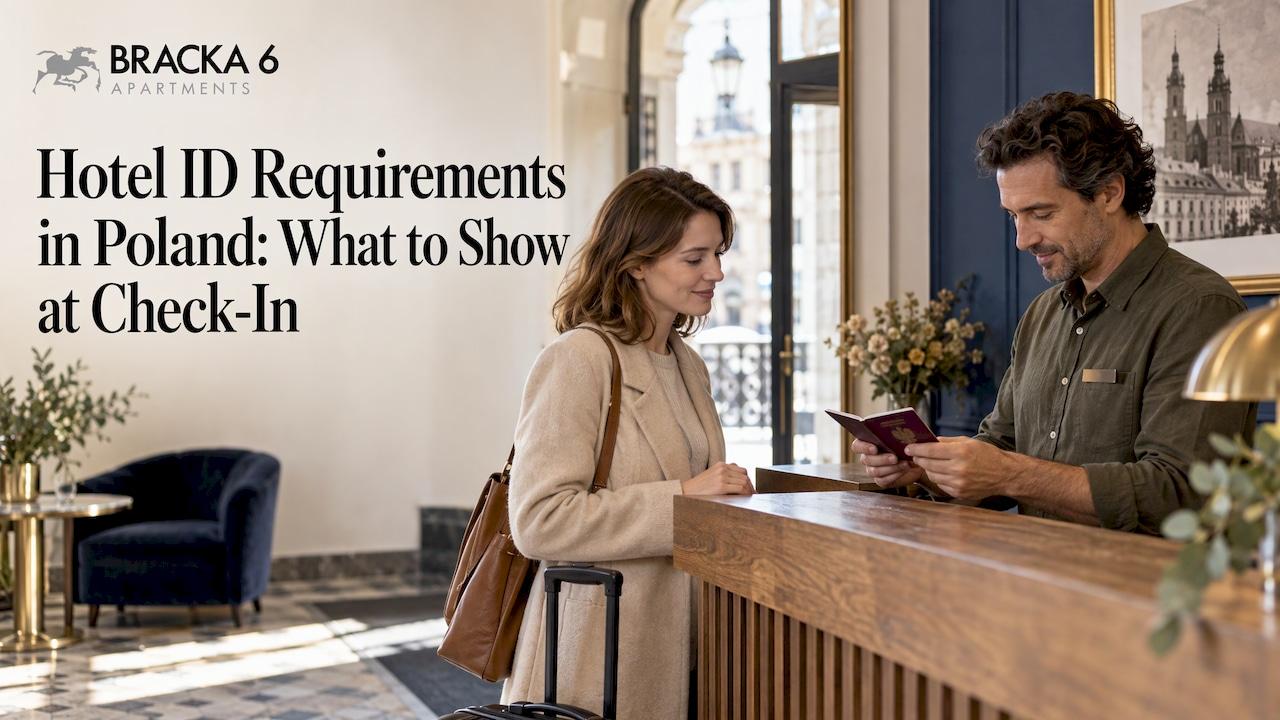
The short answer: bring the passport or national ID card you travelled on, and keep it in your hand luggage rather than the suitcase. Polish hotels expect to see a photo document at the desk, and a guest who cannot show one can be turned away. For most visitors that is the whole story. For families, couples travelling on different documents and anyone arriving late, a few details are worth knowing before you leave home.
This guide covers what Polish hotels and apartment hotels ask for, which documents work, what changes when children are travelling, what a hotel may and may not do with your document, and how to avoid problems on the day. If you are heading to Kraków, we are at Bracka 6: boutique apartments in a 15th-century townhouse, 100 m from the Main Square. The principles below apply to any accommodation in Poland.
TL;DR
- Show a valid passport or national ID card at check-in. Poland follows Schengen rules for entry, and hotels expect a photo document that confirms who you are.
- Poland's law does not list one specific document for hotels, so the passport you used to enter the country is the safest choice. Driving licences are accepted by some hotels but not by all, and some embassies warn against relying on them.
- If you travel with children, carry proof of your relationship to them. Since August 2024 accommodation providers must check that a child is with a guardian.
- A hotel may look at your document, but should not keep it as a deposit, and should not copy it without a legal basis or your agreement.
- Send your arrival time and names in advance, so check-in takes minutes rather than a discussion.
Table of Contents
- What hotels in Poland actually ask for
- Which documents work for foreign visitors
- A worked example: a couple arriving late from the airport
- Travelling with children
- What a hotel may do with your document
- Do you need to register with the authorities?
- What happens if you cannot show a document
- A short checklist before you leave home
- Staying in an old townhouse: what check-in looks like
- Why we say: have the document ready, ask us in advance
- Your arrival at Bracka 6
- FAQ
- Book direct for a smooth arrival
- Sources
What hotels in Poland actually ask for
Poland's Hotel Services Act (the law governing hotels and other accommodation) says that hotels may serve only guests whose identity has been established. In practice this means the receptionist asks to see an identity document with a photo, and the stay cannot begin without one. The Act's wording is summarised in Polish here, including the point that the law does not name a particular document.
That gap is why you will hear different answers from different front desks. The law sets the principle (identify the guest), and each property decides which documents it accepts. A passport is accepted everywhere. A national ID card from another EU country is accepted at almost every desk. Everything else depends on the property.
The hotel will also ask for a few details to fill in its guest registration form: your name, date of birth, nationality, document number and how long you are staying. Polish hospitality guidance notes that the form does not have to be on paper, and that many properties collect the same data online before arrival. The document itself is still looked at in person when you arrive.
Which documents work for foreign visitors
Passport or national ID card
A passport is the document every receptionist recognises, and it is the one you needed to get into the country in the first place. Poland follows Schengen entry rules. For British travellers, GOV.UK's Poland entry requirements say the passport must have been issued less than 10 years before the day you arrive and must be valid for at least three months after you plan to leave the Schengen area. Check both dates before you book, because a passport that fails them can stop you at the border, long before the hotel desk.
Citizens of EU countries have more flexibility. The Polish Ministry of the Interior states that an EU citizen may enter and stay with a valid travel document or another valid document confirming identity and citizenship. For a Spaniard, German or Dutch visitor, a national ID card therefore does the job at the hotel as well as at the airport.

Driving licences
Some Polish hotels accept a driving licence with a photo, and Polish legal commentary says a passport or driving licence is generally taken in place of a Polish ID card if it shows valid personal data and a photo. Do not plan around it, though. Sweden's embassy tells its citizens that during a stay in Poland they must be able to identify themselves, for example at hotel check-in, and that a Swedish driving licence is not accepted as identification because it does not show citizenship. A British paper counterpart or a US state licence raises the same question. Treat a licence as a back-up, and carry the passport.
Documents that do not count
Student cards, payment cards and similar items are not identity documents for this purpose. A photo of your passport on your phone is useful as a spare if the original is lost, but a receptionist who is asked to identify a guest will normally want the physical document.
Digital IDs
Polish citizens can use the mObywatel app as an ID. That is a Polish scheme, and it does not extend to foreign digital wallets. Visitors from the UK, US, Australia or Israel should assume that the physical passport is what is needed.
A worked example: a couple arriving late from the airport
Imagine a couple from Manchester landing at Kraków-Balice at 22:30, with a booking in the Old Town. They have two passports, both inside the checked-in suitcase, which is somewhere in the boot of a taxi. The receptionist asks for both documents, the couple has to open the suitcase on the pavement, and one passport turns out to be at the bottom.
The fix is trivial and costs nothing: keep the passports in the bag you carry on, and have the booking confirmation open on your phone. Each adult in the room should be able to show a document, not only the person who made the booking. If someone in the group has only a photo of their passport, tell the property before you travel.
On the way in you may also have shown the same passport at border control, so it should be in your hand from the plane to the desk. A short message to the property with your arrival time is useful on any trip. It lets the team prepare the registration details and plan for a late handover.

Travelling with children
Families need to read this part. Since the amendments to Polish law that came into force on 15 August 2024 (often called the Kamilek law, after a child-protection case), accommodation facilities must check the relationship between a child and the accompanying adult. According to the guidance summarised by Polish lawyers, staff may verify the link by asking for the adult's ID, the child's school ID or, for Polish residents, the mObywatel app. If a child has no document, staff record the child's name, surname, address and date of birth, and may ask for written parental consent or contact a parent.
For a family on a city break the practical advice is:
- Parents with their own children. Carry each child's passport or national ID card. If the surname differs from yours, bring something that shows the relationship, such as a birth certificate.
- A child travelling with grandparents, relatives or friends. Bring a written consent letter from a parent, with contact details. Polish sources say it is sometimes expected to be notarised, so it is sensible to ask the property about its requirements before you travel.
- School trips and group travel. The organiser should hold the consent documents for each child and share the list with the property in advance.
This is a child-safety check, not an obstacle, and a family that arrives prepared will usually be through it in a minute or two.
What a hotel may do with your document
You are allowed to ask what happens to your data. Polish lawyers working on data protection set out the rules clearly:
- A hotel may ask to see your ID to confirm who you are, to check the registration data or to confirm the reservation.
- It may not copy or write down the whole document (number, personal number, photo) without a legal basis or your voluntary consent. The GDPR principle of data minimisation means collecting only what is needed, such as name, address and dates of stay.
- Leaving your ID at reception as a deposit is not acceptable. The same legal article describes it as illegal, and a hotel should ask for a card payment guarantee or a booking-based arrangement instead.
In short, the receptionist looks at the document, notes the details the registration form requires, and hands it back. If a desk wants to scan or photocopy your passport, ask why and for how long the copy is kept. Many properties now use scanners that read only the needed fields, and that is a normal, reasonable answer.

Do you need to register with the authorities?
Not as a typical tourist. The hotel's own guest form is a business and tax record, not a residence registration. Polish rules on registering a place of stay concern longer residence, and the Ministry of the Interior's guide to entry and residence rules describes the framework for EU citizens staying up to three months. A weekend in Kraków does not require any visit to an office.
One change is worth knowing about if you read Polish news: a plan to create a central register of tourist accommodation has been discussed in parliament, with booking platforms passing stay data on. It concerns hosts and platforms, not what guests carry in their pockets, and for you the advice stays the same.
What happens if you cannot show a document
If you have lost your passport or left it at home, a hotel may refuse check-in, because the law requires the guest to be identified. Some properties will consider alternatives, such as a photo ID of another kind together with reservation details, but this is at the property's discretion and should never be assumed.
If your passport is lost or stolen during the trip, report it to the local police and contact your embassy or consulate for an emergency travel document. A police certificate of the loss is something hotels may accept for a short period. Keep the number of the emergency services in your phone: our guide to emergency numbers in Poland explains 112 and the others.
A short checklist before you leave home
| Check | Why it matters |
|---|---|
| Passport issued less than 10 years before arrival and valid 3 months beyond departure (UK and other non-EU visitors) | Schengen entry rule |
| Passport or ID card for every adult in the room | Each guest may be asked to identify themselves |
| Child's document and proof of relationship | Guardian check at accommodation since August 2024 |
| Parental consent letter if a child travels without a parent | May be requested by the property |
| Arrival time sent to the property | Smooth handover, especially late at night |
| Document kept in hand luggage | Avoids opening the suitcase at the desk |
The general list of what to have ready on any trip abroad is in our guide to hotel check-in requirements. If you are planning around the day itself, our notes on late check-out in Poland and hotel cancellation policies in Poland cover the other two questions that usually come up at the desk.
Staying in an old townhouse: what check-in looks like
An apartment hotel inside a historic building works like any other accommodation when it comes to documents: you show your ID, the details are recorded and you receive your keys. The difference is in the building. Many Old Town houses are centuries old, with narrow entrances and staircases, so arriving with your documents ready and your luggage organised makes the handover easier. Our guide to comfort checks in heritage hotels explains what to expect from such a building.
Why we say: have the document ready, ask us in advance
At Bracka 6 our guests range from couples on a weekend break to families and travellers on business, and the questions about documents are always similar: which one, for whom, and what happens to it afterwards.
Our view is simple. A boutique apartment in a 15th-century townhouse, 100 m from the Main Square, should be easy to arrive at. That means knowing before you fly what to carry, telling us when you land, and having the same answer for every guest in the room. Our apartments are designed for two to four guests, so a family or a small group can arrive together with their documents in one place.
Our booking terms are published in the Regulamin, and if you are unsure about a document or a child's paperwork, write to us before the trip and we will answer in plain terms. Airport and railway station transfers are available too, which helps when you land late and want to reach the door without hunting for a taxi.
Antek
Your arrival at Bracka 6
Our apartments in Kraków's Old Town come in four types: Studio Superior, Studio Deluxe, Studio Executive and the Apartament. Each has air conditioning, a kitchen area, a private bathroom and free Wi-Fi, with daily cleaning. A continental breakfast is served at the Sempre Bracka restaurant, and packed lunches can be arranged for early departures. We also offer transfers from Kraków-Balice airport and from Kraków Główny station. See the apartments and availability on bracka6.pl.

Once you are settled, the Old Town is walkable. Our guides to Kraków public transport tickets, a local SIM card and tipping in Poland cover the rest of the practical questions, and a few Polish travel phrases will make the desk conversation friendlier.
FAQ
Do I need a visa to stay in a hotel in Poland?
The hotel does not ask for a visa as such. Entry is governed by Schengen rules, and visa requirements depend on your nationality, so check the official entry guidance for your passport. UK travellers can read the GOV.UK entry requirements for Poland. Once you are in the country, the hotel only needs to identify you.
Can I check in with a photo of my passport on my phone?
It is safest to assume not. The law says the guest's identity must be established, and receptionists expect the physical document. A photo is a useful spare if the original is lost, and a registration form can be completed online beforehand, but the document itself is shown on arrival.
Can the hotel keep my passport overnight?
No. A hotel may look at the document and note the required details, but holding an ID card as a deposit is described by Polish lawyers as illegal. If anything is unclear, ask politely what the hotel needs and why.
What do I need if I am travelling with my children?
Bring each child's passport or ID card, and proof of your relationship if surnames differ. If a child travels with someone other than a parent, carry a written consent from a parent. Rules have applied to accommodation providers since 15 August 2024.
Does everyone in the room need to show ID?
Expect each adult to be asked. The registration form collects details of every guest, so having every passport or ID card to hand is the quickest route to your keys.
Book direct for a smooth arrival
Ready to see Kraków's Old Town from your own apartment? Book direct with Bracka 6 and send us your arrival time and guest names before you travel.
Sources
- Entry requirements, Poland travel advice (GOV.UK)
- Entry and residence rules (Polish Ministry of the Interior)
- Ambassadens reseinformation, Polen (Sweden Abroad)
- Weryfikacja osób przyjeżdżających do hotelu (PCS Legal)
- RODO na wakacjach (Łukasz Hałatek, attorney)
- Zameldowanie w hotelu bez dowodu
- Zameldowanie online: jak zebrać dane gości przed przyjazdem
- Traveling with children in Poland: new requirements for documents