
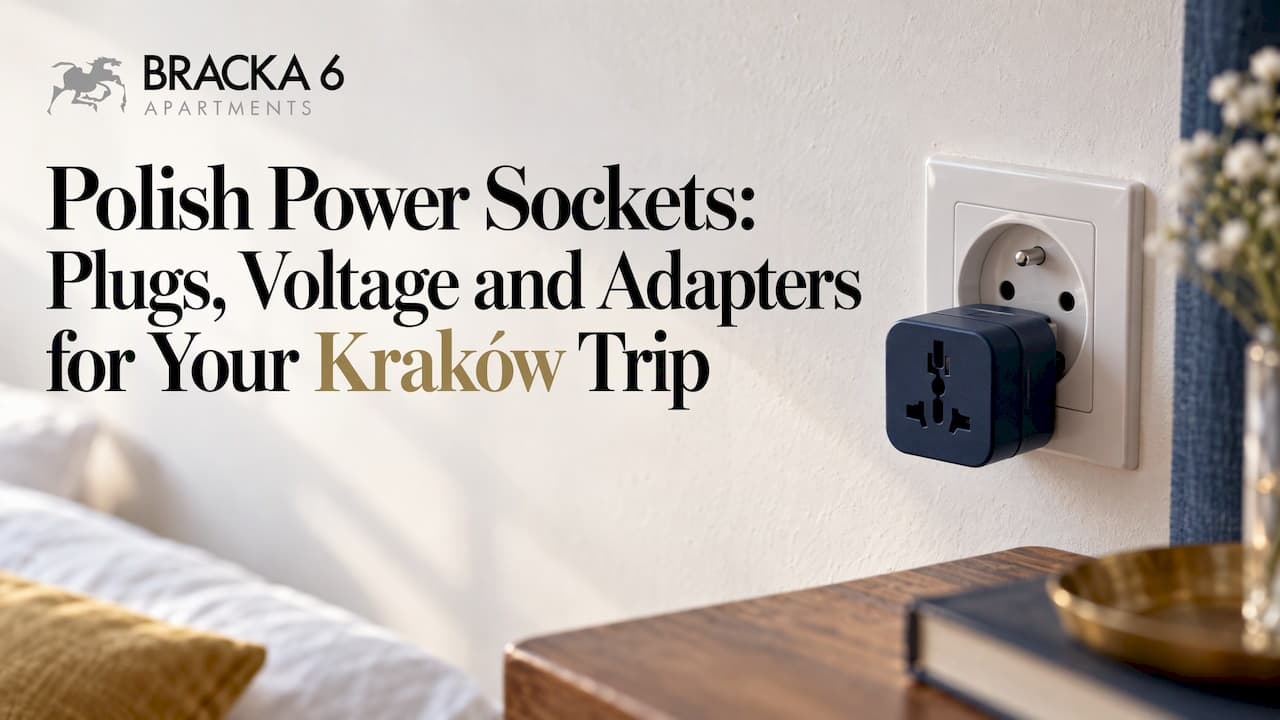
Poland uses the same two-round-pin sockets as much of continental Europe, with mains power at 230 V and 50 Hz. If you are travelling from the UK, the US, Australia or Israel, you will almost certainly need a plug adapter. Whether you also need a voltage converter depends on the label printed on each device, and for most phone, camera and laptop chargers it does not.
This guide covers the socket type, the voltage, the adapter you should pack, what to do with hairdryers and other heat-producing gadgets, and how to plan charging for a few days in Kraków's Old Town.
TL;DR
- Poland uses plug types C and E, and the sockets are type E: two round holes with an earthing pin sticking out of the wall plate.
- Mains is 230 V at 50 Hz, the same basic standard as the rest of the European Union.
- UK, US, Australian and Israeli plugs need a plug adapter for the shape. An adapter does not change voltage.
- Look for "100-240V" on your charger. If you see it, an adapter is all you need. If you see only "110-120V", you need a converter or a different device.
- Pack one multi-port USB charger and a short extension lead rather than several adapters.
Table of Contents
- Which plugs and sockets Poland uses
- What voltage and frequency to expect
- Do you need an adapter, a converter, or neither?
- What to pack, by where you are flying from
- Choosing the right adapter
- Charging your devices in an Old Town stay
- Our perspective on packing for Kraków
- Staying near the Main Square
- Common mistakes to avoid
- A short packing checklist
- FAQ
- Sources
Which plugs and sockets Poland uses
Poland's official plug types are C and E. The US Department of Commerce's country information page lists types C and E for Poland, and the city's own visitor guide describes the 230 V, 50 Hz type E plug with two round pins as the one used across much of Europe.
In practice, here is what you will see on the wall:
- Type E sockets have two round holes and a metal earthing pin that protrudes from the centre of the socket, above the holes. Plugs made for them have two round pins and a matching hole for that earthing pin.
- Type C plugs are the slim, two-pin, ungrounded plugs found on many small chargers, shavers and travel gadgets across Europe. They fit into Polish sockets.
The earthing pin is not a quirk. Sockets with a protective earth contact are the norm in newer and renovated Polish installations, and the earth connection is there to carry fault current safely away. That matters to you for one reason: a plug with a rigid, wide, earthed body will only go in if it has the right hole for the pin.
How to recognise a socket in a few seconds
Look at the wall plate. If you see a small metal pin standing up in the middle above two round holes, it is type E. The sockets are generally recessed slightly into the plate, so a plug sits firmly once pushed home. Push it all the way in before you judge whether the connection is working; a half-inserted adapter is the most common reason a charger seems dead.
What voltage and frequency to expect
Household electricity in Poland is single-phase alternating current at a nominal 230 V and 50 Hz, as Poland's national education platform explains. That is the same nominal figure used across most of Europe, so travellers coming from other European countries rarely have to think about it.
Two things are worth knowing:
- Voltage in any grid drifts slightly around its nominal value. You do not need to do anything about this; any modern charger is built to tolerate normal variation.
- Frequency matters only for a handful of devices. UK-bought equipment and European equipment are designed for 50 Hz. Travellers from North America should know that a 60 Hz appliance can behave differently on 50 Hz.
The UK electrical safety charity Electrical Safety First makes the general point that you should check the socket type, voltage and frequency of the country you are visiting, and that in most cases you will need a travel adaptor. It also notes that when the frequency differs, some appliances may work but not properly, using a 50 Hz clock running fast on a 60 Hz supply as an example.
Do you need an adapter, a converter, or neither?
These are two different pieces of kit, and mixing them up is the commonest mistake.
- A plug adapter changes the shape of the pins so your plug physically fits the socket. It does nothing to the electricity.
- A voltage converter or transformer changes the voltage. It is needed only when a device is built for a different mains voltage and cannot cope with 230 V.
Electrical Safety First puts it plainly: where the supply voltage differs, you need a transformer or converter unless the appliance or its power supply is dual-voltage rated.
Read the label, not the plug
Turn your charger over. On the small print you are looking for the input line:
| What the label says | What it means in Poland |
|---|---|
| Input: 100-240V, 50/60 Hz | Works on 230 V. You only need a plug adapter. |
| Input: 220-240V, 50 Hz | Made for this supply. You only need a plug adapter if the plug shape differs. |
| Input: 110-120V only | Not suited to 230 V. Use a converter or leave it at home. |
| No input line at all | Treat as unknown. Do not plug it in until you have checked the manual or manufacturer. |
Most phone chargers, laptop power bricks, camera battery chargers, e-reader chargers and power banks carry the wide 100-240V range, so for them the adapter is the whole story.
Heat-producing gadgets are the exception
Hairdryers, curling tongs, straighteners, travel kettles and electric shavers are where problems arise. Many are single-voltage. A device marked for 110-120V only and plugged into 230 V through a simple adapter can be damaged and can be a fire risk. If you are travelling from the US or another 110-120 V country and want to bring a styling tool, check that it has a voltage switch or a dual-voltage label, and use a converter rated for its wattage only if the manufacturer says that is appropriate. If in doubt, ask an electrician or the manufacturer before you travel.
Owners of UK-bought equipment can usually relax: the issue is shape, not voltage, but still glance at the label on anything unusual.
What to pack, by where you are flying from
From the UK or Ireland
Your three-pin plugs will not fit. You need an adapter to a two-round-pin European plug. Because Polish sockets are recessed and earthed, choose an adapter with a sturdy body that sits firmly in the wall, and test it with a lamp or phone when you arrive. If you bring a UK extension lead with several sockets, one adapter on its plug powers everything on it, provided the combined load is within what the extension lead is rated for.
From the US or Canada
American Type A and B plugs do not fit Polish outlets, so you need an adapter. Your phone, tablet and laptop chargers are almost certainly dual voltage, which means an adapter is enough. Treat anything with a heating element separately, as above.
From Germany, Austria, the Netherlands and most of the EU
This is the easy group. Many continental appliances carry a Type C plug, and Type C plugs fit Polish sockets. Some people ask about the German Schuko plug: a bare Schuko is not the same as the slim plug and may not enter an earthed Polish socket, but many appliances sold today carry a hybrid E/F plug that is designed to work with both. Check what is physically on the end of your cable, and if it is a large square-shouldered Schuko without the hole for the pin, carry a small adapter or a Type C lead as backup.

From Spain, Norway and Benelux
The standard two-round-pin plugs used in these countries generally fit Polish sockets. Norwegian and Spanish travellers can usually travel without an adapter if their plugs are the slim type; take a spare anyway if you have a bulky earthed charger.
From Australia and New Zealand
Your angled flat-pin plugs will not fit, so an adapter is essential. Most modern electronics are dual voltage, so no converter is needed for them.
From Israel
Israeli plugs differ from the Polish standard in shape, so pack an adapter. Many Israeli-sold devices accept 230 V already, but check each label for the input line.

Choosing the right adapter
You do not need anything complicated. A few practical points save frustration:
- Pick one that accepts your plug and outputs type C/E-compatible round pins. This is the whole requirement for a plug adapter.
- Prefer a multi-port USB charger on top of the adapter. If your travel party carries two phones, a tablet and a watch, one USB charger with several ports avoids a pile of adapters.
- Bring one extension lead with several outlets if you travel with a partner or children. One adapter, many devices.
- Check amperage on anything you plug into an adapter. A cheap adapter suits chargers; it is not meant for high-power heating devices.
- Pack it in your hand luggage so that it is with you when you arrive late and the shops are shut.
If you leave it behind, small shops, electronics stores and airport kiosks in Kraków sell adapters, but arriving with one saves a hunt after a long travel day.
Charging your devices in an Old Town stay
The days of a city break are packed with photos, maps and translation apps. Phones are the heaviest drain. A few habits help:
- Charge overnight and carry a power bank for the day.
- Keep your SIM or eSIM plan sorted before you land so you are not draining the battery searching for networks. Our guide to buying and registering a SIM card in Kraków walks you through it.
- If you arrive early or leave late, you may be on the move between check-out and your flight with a flat battery. Our note on where to leave your bags in Kraków helps you plan the gap and charge before heading to the airport.
- Keep cables short and labelled. In a compact apartment, a tidy charging corner beats a tangle across the table.
Old buildings are part of Kraków's character, and in a historic townhouse you may find that outlet positions reflect the age of the building rather than modern habit. That is one more reason a short extension lead is worth packing. If you want to understand what to expect from a historic stay in general, our piece on comfort checks for heritage hotels is a useful companion.
Our perspective on packing for Kraków
We have welcomed guests from the UK, the US, Spain, Norway, Germany, the Benelux countries, Australia and Israel, and the same small questions come up at the front door: which plug, and will my charger survive?
Our advice is simple. Bring one adapter that suits your home plug, and read the label on each charger before you leave. If it says 100-240V, you are done. The things that cause trouble are almost always hairdryers and styling tools, so if you can, leave them at home and use what is provided in your apartment.
We designed our apartments in a 15th-century townhouse for guests who want to unpack once and enjoy the city. That means you can plan your days around the Main Square, which is a short walk away, and not around your battery. Charge overnight, carry a power bank for the day, and keep a spare adapter in your day bag in case a friend needs one.
If you are unsure about any device, message us before you travel and we will tell you what we can about our apartments.
Antek
Staying near the Main Square
If you are planning a city break and want to be within a short walk of the sights, our boutique apartments at Bracka 6 sit in a 15th-century townhouse 100 m from Kraków's Main Square. The apartments are designed for two to four guests and come with air conditioning, a kitchen area, a private bathroom and free Wi-Fi, so you can work, plan the next day and charge up in comfort. Breakfast is served in the on-site restaurant, and packed lunches are available if you are leaving early. Airport and railway station transfers can also be arranged.

See the apartment types and availability on the Bracka 6 website, and read the booking terms before you confirm. If you are weighing up the style of stay, our comparison of an aparthotel versus a hotel explains what each offers.
Common mistakes to avoid
Assuming an adapter converts voltage. It does not. A plug adapter only changes the pin shape. Check the label.
Forcing a plug into a socket. If it does not go in smoothly, it is the wrong shape. Do not push, do not bend pins, and do not stack adapters to reach a hard-to-reach socket.
Bringing a high-wattage heater or kettle on a cheap adapter. Small adapters are for chargers. Anything that makes heat is better left at home.
Ignoring frequency for clocks and motors. For phones and laptops it makes no difference. For older clocks, turntables or timers built around the mains frequency, it can.
Forgetting the second plug. Tablet, phone, watch, earbuds and camera all want power at the same moment each night. One multi-port charger solves it.

Buying an adapter at the airport on arrival. It is possible, but it is easier to pack one at home.
A short packing checklist
- One plug adapter that fits your home plug to type C/E round pins
- One multi-port USB charger
- A short extension lead if you carry more than four devices
- A power bank for sightseeing days
- Cables, labelled
- Dual-voltage check for any styling or grooming tool
- Offline maps and tickets downloaded before you go; for local transport, see our guide to Kraków public transport tickets
FAQ
What type of plug is used in Poland?
Poland uses type C plugs and type E sockets. The sockets have two round holes and an earthing pin in the wall plate. Type C two-pin plugs fit them, as do the round-pin plugs used in much of continental Europe.
Do I need a plug adapter in Poland?
If you come from the UK, the US, Australia or Israel, yes. Your plugs have a different shape. Travellers from much of continental Europe can often use their own plugs. Electrical Safety First advises that in most cases a travel adaptor will be needed when going abroad.
What is the voltage in Poland?
The nominal voltage in Polish homes is 230 V at 50 Hz, according to Poland's national education platform. Most modern phone and laptop chargers accept this without a converter.
Do I need a voltage converter as well?
Only for devices built for a lower voltage only, such as those labelled 110-120V. If your charger says 100-240V, an adapter is enough. For hairdryers and other heating devices, check the label or the manufacturer's guidance first.
Can I use my UK plug in Kraków?
Not without an adapter. Pack one that converts your three-pin plug to round pins, and check the label of any unusual device.
Sources
- Poland: Electric Current Information, US Department of Commerce
- Kraków Basics, Visit Krakow
- Jaki prąd płynie w domowej instalacji, Zintegrowana Platforma Edukacyjna
- Travel Adapter: Information for Travellers, Electrical Safety First