
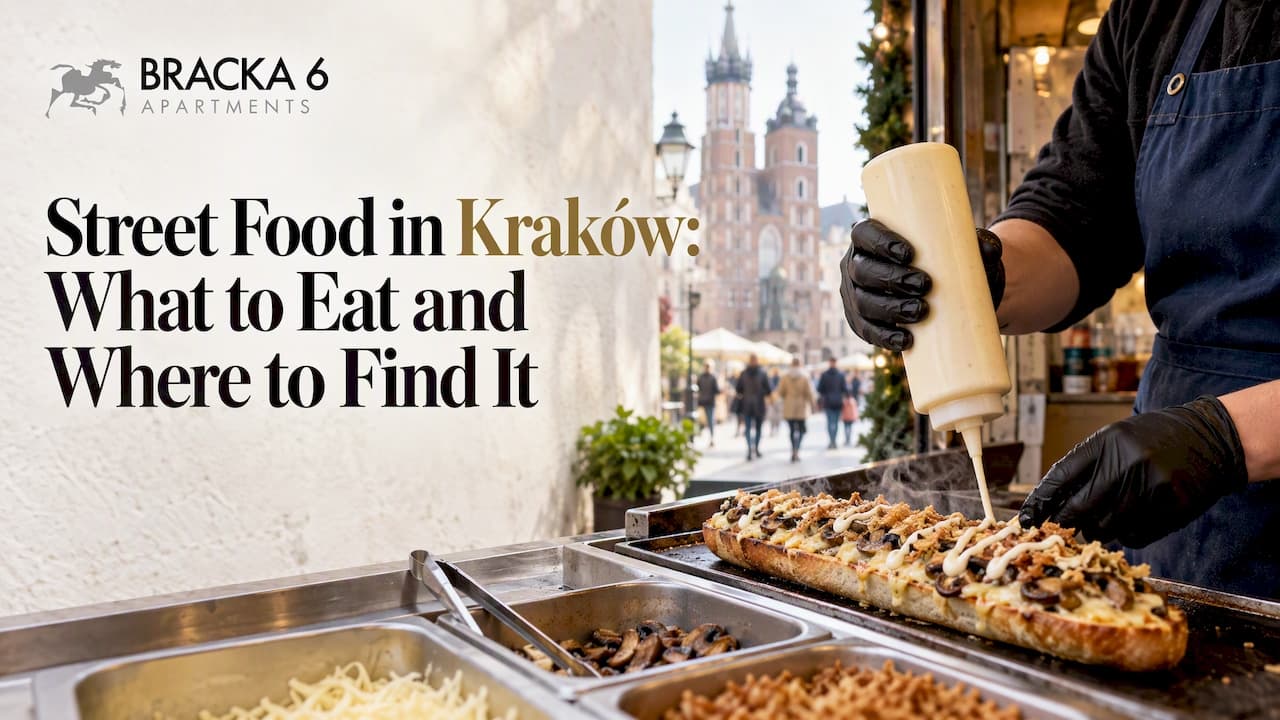
Kraków's street food comes down to a handful of dishes: a chewy ring of bread sold from carts, a long toasted baguette called zapiekanka, a slow-cooked pork sandwich called maczanka, and grilled sausages after dark. All are cheap to try and easy to fit between sights. Most are within a short walk of the Main Square, and the best-known zapiekanka spot is across the Old Town in Kazimierz.
This guide explains what each dish is, where to look, and how to plan a day of eating on foot.
TL;DR
- Start with an obwarzanek krakowski, the braided bread ring sold from street carts, which has EU-protected status and is not a bagel.
- Eat a zapiekanka at Plac Nowy in Kazimierz, where the round Okrąglak building sits in the middle of the square.
- Try maczanka krakowska, a shredded pork sandwich in caraway sauce, for the most local order on the menu.
- After dark, follow the locals to simple grilled-sausage vans rather than the busiest tourist streets.
- Keep the evening friendly: Kraków's night-time scene works best when visitors respect residents and local quiet rules.
Table of Contents
- What counts as street food in Kraków
- Obwarzanek krakowski: the ring you will see on every corner
- Zapiekanka: the open-faced baguette that Kazimierz made famous
- Maczanka krakowska: the most local sandwich
- Late-night sausages: where locals go after dark
- A day of eating on foot
- Getting more from food in Kraków
- Our perspective: eat simply, walk, come back to a quiet room
- Eating out at night: a few courtesies
- Stay close to the food
- FAQ
- Book direct
- Sources
What counts as street food in Kraków
In Kraków the phrase covers more than stalls. The city's own culinary portal describes street food here as not merely modern fast food but something rooted in regional history, from old market stalls to today's food-truck festivals. It also notes that places hard to call restaurants fill up late at night, once the restaurants have emptied: burgers, falafel, tortillas, chips, sausages and maczanka.
The habit is old. A city culinary publication traces descriptions of eating on the street back to the 16th-century writer Mikołaj Rej, who sent the hungry to the Kraków market square. So when you buy a snack in the Old Town, you are joining a very long queue.
For a visitor, it helps to think in three groups:
- Bread snacks you eat while walking: obwarzanek, and zapiekanka.
- Hand-held meals that replace a sit-down lunch: maczanka, pierogi to go, kebabs and burgers.
- Late-night grills for the hour after the bars: sausages in rolls, chips, wraps.
Obwarzanek krakowski: the ring you will see on every corner
The first thing you will notice is the carts. Many sell obwarzanki, braided rings of dough that are parboiled and then baked, sprinkled with poppy seed, sesame or salt. The name comes from the Polish verb for parboiling, which is the whole trick.

The official description from Poland's Ministry of Agriculture is precise: a spirally twisted ring, 12 to 17 cm across and 120 to 200 g. The product is listed as a traditional Polish product and carries EU protected geographical indication. That is why you will hear locals insist on the word "krakowski".
Obwarzanek or bagel?
Visitors often call it a bagel. The regional tourist board draws the distinction: the obwarzanek is a different, protected product, separate from the Jewish-style bagel that is said to have originated in Kraków before travelling west. The texture is the giveaway. It is chewy, a little sweet, with a crisp outside, and it is lighter than most bagels you will have eaten in London or New York.
How to eat it
- Buy it plain, with poppy seeds or with sesame, and eat it fresh.
- It is a snack, not a meal. Think of it as a walking breakfast on the way to Wawel.
- Carts are most common near the Main Square, Planty park and the main routes between the station and the Old Town.
If you want the longer story of what Poles eat in the morning, our host's guide to Polish breakfast foods pairs well with this one.
Zapiekanka: the open-faced baguette that Kazimierz made famous
Zapiekanka is the dish readers most often ask about. Picture half a long baguette, topped with sautéed mushrooms and melted cheese, grilled until bubbling, then finished with ketchup or other sauces. It is somewhere between an open-faced sub and a pizza, and it is the classic Polish late-night snack.
The address to know is Plac Nowy in Kazimierz. Okrąglak stands in the middle of the square at Plac Nowy 4B, which makes it an easy landmark to find. Hatches around the building serve zapiekanki, and the square is the natural meeting point for an evening in the former Jewish Quarter.
Ordering tips
- Queues move quickly. Decide on your topping while you wait.
- Classic means mushrooms and cheese. Many hatches add ham, chicken, or vegetarian variations.
- Check opening hours on the day, as they vary and change by season.
- Eat it standing or on a nearby bench. It is messy and best hot.
A zapiekanka makes a good bridge between daytime sightseeing and dinner, or a good dinner in itself if you have walked all day.
Maczanka krakowska: the most local sandwich
If you only try one dish that you cannot easily find at home, make it maczanka. The regional tourist board describes it as a traditional sandwich of long-baked, shredded pork loin or neck in a caraway sauce on a roll, dating back as far as the 16th century, and it is often called the ancestor of the hamburger.
Expect rich, soft meat, a savoury, slightly peppery sauce that soaks into the bun, and a satisfying lunch. Look for it at small counters and casual eateries rather than on cart menus. It is not as ubiquitous as zapiekanka, so ask for it by name.

We are often asked whether this is the dish that locals themselves eat. Yes: it is a Kraków original, and a good test of whether a casual place takes local food seriously.
Late-night sausages: where locals go after dark
The city's culinary portal gives one of the more charming tips for an authentic evening: skip the busiest tourist streets and head for the blue Nysa van near Hala Targowa. It has served grilled sausages in rolls to locals, taxi drivers and night-shift workers for more than 20 years.

That is the point of street food in Kraków after dark. It is cheerful, unfussy and filling. Order a sausage in a roll, add mustard, and eat it on the spot. Vans and hatches like this are not for lingering, so plan your seat-down meal elsewhere.
A day of eating on foot
Here is a simple route that keeps you walking and eating without a reservation.
| Time | What | Where |
|---|---|---|
| Morning | Obwarzanek from a cart | Near the Main Square or Planty |
| Midday | Maczanka sandwich | A casual counter in the Old Town |
| Afternoon | Wander the market stalls | Stary Kleparz farmers' market, a short walk north of the Old Town |
| Early evening | Zapiekanka | Plac Nowy, Kazimierz |
| Late | Grilled sausage in a roll | Hala Targowa area |
If you are planning the rest of your time, our one day in Kraków on foot route and 3-day itinerary show how to fit the food stops around the main sights.
Getting more from food in Kraków
Street food is the start. If you enjoy eating your way through a place, a good approach to food experiences is to treat them as part of the day, not a checklist. This general guide to enjoying local food experiences is a useful read before a trip: it encourages asking questions and tasting widely, and both ideas work well in Kraków.
For Kraków specifically, the city's Historic Culinary Trail is a good companion. The city presents it as a walk through the places that shaped Kraków's food heritage, where architecture and flavour meet.

Our perspective: eat simply, walk, come back to a quiet room
We run Bracka 6, a set of boutique apartments in a 15th-century townhouse, 100 m from Kraków's Main Square. Our guests ask about street food nearly every day, so here is how we think about it.
First, don't over-plan. The dishes above are cheap to try and need no booking, so they suit a city break where you also want museums, a church or two and a long coffee. Second, mix. A light obwarzanek in the morning, a proper sit-down meal in the evening, and one late-night snack at Plac Nowy is a better rhythm than three snacks a day. Third, think about where you sleep. After a late zapiekanka, being a few minutes from the Main Square on foot means you walk back, rather than wait for a taxi.
Our apartments have a kitchen area, which many guests use for fruit, cheese and bread from the market, but we also serve a continental breakfast at the Sempre Bracka restaurant, and can prepare packed lunches for early starts. If you are weighing up a hotel against an apartment, our aparthotel vs hotel guide sets out the trade-offs honestly, and our note on heritage hotels explains what to check in an old building.
— Antek
Eating out at night: a few courtesies
Kraków is a safe city for visitors. The city's own site reports that 85.9% of residents rated it safe as of March 2026, and cites a 2025 Safest Destinations Index that ranks it fifth safest in Europe. Ordinary city sense still applies, as it does anywhere.
The Old Town is also where people live. Kraków's Night Mayor, Jacek Jordan, has spoken of dialogue between residents, businesses and visitors, and visitors are asked to respect noise rules and act responsibly. In practice: keep your voice down in courtyards and on small streets late at night, and finish your sausage and sauce before you stroll.
If you sit at an outdoor table, note that the city has published guidance on checking whether a restaurant garden is legal, which is mainly aimed at residents. As a visitor, simply choose places that look established and tidy.
Stay close to the food
Walking distance matters on a food trip. Our Studio Superior, Studio Deluxe, Studio Executive and Apartament options sleep two to four guests, with air conditioning, a kitchen area, private bathroom, free Wi-Fi and daily cleaning. We can also arrange transfers from Kraków-Balice airport and Kraków Główny station. See the full range on the Bracka 6 website, and read our booking terms before you reserve.
FAQ
What food is Kraków famous for?
Obwarzanek krakowski, the braided bread ring with EU protected status, is the best-known item. Zapiekanka, the toasted open baguette, and maczanka, a shredded pork sandwich in caraway sauce, round out the street-food trio. Pierogi and sausages are common too.
Where do locals eat in Kraków?
Locals use casual counters, market stalls and late-night vans as much as restaurants. The city's culinary portal singles out a long-running grilled-sausage van near Hala Targowa that serves taxi drivers and night-shift workers. Plac Nowy in Kazimierz is the classic meeting point for zapiekanki.
Is Kraków street food safe to eat?
Carts, hatches and stalls that are busy and visibly turning over food are a sensible choice, as in any city. Pick hot, freshly made items, and avoid anything that has clearly been sitting. If you have an allergy, tell the vendor in simple Polish or show a written note; our Polish travel phrases guide includes useful words. For medical allergies, talk to your doctor before travelling.
Can I find vegetarian street food in Kraków?
Yes. Zapiekanka with mushrooms and cheese is vegetarian in its classic form, though sauces vary. Falafel and wraps are widely available, as the city's culinary portal notes. Ask what is in a dish before ordering.
Book direct
Planning a Kraków city break? Book your stay directly with Bracka 6 at bracka6.pl and wake up 100 m from the Main Square, ready for your first obwarzanek.
Sources
- Obwarzanek krakowski, Ministry of Agriculture and Rural Development, gov.pl
- Street food in Kraków and Małopolska, VisitMalopolska
- Kraków culinary portal
- Kraków culinary publication on street food history
- Historic Culinary Trail, City of Kraków
- Restaurant garden legality check, City of Kraków
- City of Kraków official website
- Zapiekanki Okrąglak, Miasto Kraków guide
- How to enjoy local food experiences