
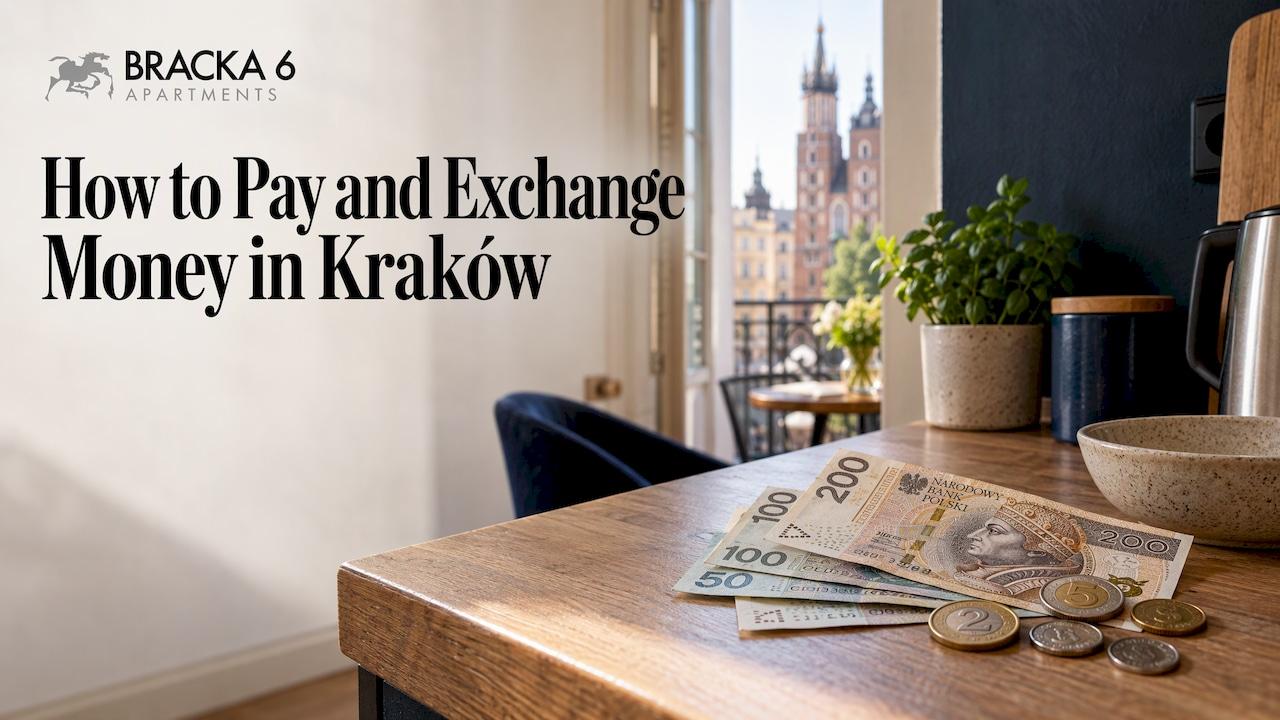
Kraków uses the Polish złoty (PLN), not the euro. Cards work almost everywhere in the centre, so most visitors only need a small stash of cash. The easiest way to get it is a withdrawal from a bank-branded ATM. If you do change money, compare rates before you hand anything over, and always pay in złoty, not in your home currency.
This guide covers the coins and notes you will see, whether euros are ever worth offering, how Old Town exchange offices (kantors) make their money, and the card and ATM habits that save you the most. It is written for city-break visitors arriving from the UK, the US, Europe, Israel and Australia.
TL;DR
- The currency is the złoty (code PLN, symbol zł). Poland is not in the euro system, so pay in złoty.
- Visa and Mastercard are accepted almost everywhere in the centre, and contactless is standard. Carry a little cash for markets, milk bars and tips.
- When a card machine or ATM offers to charge you in your home currency, decline and choose PLN.
- At a kantor, look at the gap between the buy and sell rates, not at the words "no commission".
- Bank-branded ATMs are the simplest source of cash. Avoid standalone machines in tourist spots.
Table of Contents
- The złoty: code, symbol and what the money looks like
- Can you use euros in Kraków?
- Cards, contactless and how much cash to carry
- Getting złoty from an ATM
- The conversion trap: always pay in złoty
- Exchanging cash at a kantor
- Which option suits which traveller?
- Keeping your money safe in a busy centre
- Perspective: why we tell guests to keep it simple
- Staying close to everything in the Old Town
- Before you fly: a short checklist
- FAQ
- Sources
The złoty: code, symbol and what the money looks like
Poland's official currency is the złoty, written PLN in banking and zł on price tags. It is divided into 100 groszy. According to Poland Travel, the coins are 1, 2 and 5 PLN plus 1, 2, 5, 10, 20 and 50 groszy, and the banknotes are 10, 20, 50, 100 and 200 PLN.
Two practical points. First, the 200 PLN note is awkward for small purchases at a kiosk or a bakery, so break larger notes in a supermarket or a restaurant where you are spending more. Second, prices in Kraków are shown in złoty even in places that cater heavily to tourists, so get used to a rough mental conversion early. Halving the figure is a crude but workable guide to pounds or dollars before you check the live rate on your phone.
Can you use euros in Kraków?
No, not as a normal way to pay. Poland is outside the eurozone and, as Poland Travel states, its legal tender is the złoty. Some tourist-facing shops and hotels near the Main Square may take euros as a favour, but when they do, the conversion is set by them and is rarely in your favour. The simple rule: if a seller offers to take euros, pay in złoty by card instead.
The same goes for pounds, dollars and everything else. Foreign banknotes are only useful as something you can change into złoty at a bank or a kantor. If you are arriving with leftover euros from another trip, change them before or after a stay in Kraków rather than trying to spend them here.
Cards, contactless and how much cash to carry
For most visitors, a debit or credit card does most of the work. Kraków's official tourism service says that banks and ATMs in the Planty ring and around the Main Market accept most payment cards, and that only a small number of shops take cash only (Kraków tourism portal).
A 2026 guide to the city reports that cards are taken almost everywhere in the centre, including restaurants, hotels, shops and museums, and suggests having around 200 to 400 PLN in cash for markets, milk bars and tips (Kraków Trip). That is a sensible ceiling for a weekend. If you would rather carry less, a smaller float still covers the odd cash-only stall.
On card types, The Poland Guide says Visa and Mastercard are accepted almost universally in major Polish cities including Kraków, while American Express is less common. It also reports that contactless payments up to 100 PLN need no PIN, with larger amounts asking for one. If you travel with an Amex, bring a second card as a back-up.
What cash is still handy for
- Tips in restaurants and bars when you want to leave something directly.
- Small purchases at open-air markets and stalls.
- Milk bars (traditional canteens), some of which prefer cash. If you are planning to eat on the move, our guide to street food in Kraków shows what you are likely to buy.
- Public toilets and the odd small shop.
For trams and buses, check how to pay before you board. Our guide to Kraków public transport tickets explains what to buy and how to validate it.
Getting złoty from an ATM
Withdrawing from a cash machine is the least fussy way to get złoty. Cash points are easy to find in the Old Town: one Kraków guide lists machines on Grodzka and Floriańska, at Galeria Krakowska, at the airport and in Kazimierz (Kraków Trip).
Three habits make the difference:
- Choose a bank-branded machine. The same guide recommends ATMs belonging to banks such as PKO Bank Polski, Pekao, mBank, ING and Santander Poland, and advises avoiding standalone machines in tourist areas, where it says fixed fees can reach 20 PLN per withdrawal.
- Decline conversion. If the screen offers to bill you in pounds, dollars or euros, choose PLN. More on that below.
- Protect your PIN. Cover the keypad and check your statement during the trip, as recommended by a 2026 Kraków safety guide.
Also check your own bank's foreign-transaction and cash-withdrawal charges before you leave, as VisitPolska advises. Your home bank, not Kraków, sets those fees, and some travel-friendly cards waive them.

The conversion trap: always pay in złoty
Dynamic currency conversion (DCC) is the offer at a card terminal or ATM to "pay in your own currency". It looks helpful, since you see a familiar figure. In practice the terminal supplies the exchange rate. The Poland Guide says that choosing your home currency typically gives the merchant's rate, which it describes as 3 to 5% worse than your bank's.

Selecting PLN instead leaves the conversion to your card issuer, which is the route VisitPolska recommends for both card payments and ATM withdrawals. The prompt is easy to miss when you are tired at the end of a dinner, so make it a habit: whenever the machine asks, press the złoty option.
Exchanging cash at a kantor
Some visitors still like to change a small amount of cash on arrival. Kraków's official tourism service says you can exchange money at banks and at kantors, and notes that banks generally charge a commission, which makes them less advantageous. It recommends checking and comparing kantor rates (Kraków tourism portal).
How a kantor makes its money
Private kantors usually do not charge a fixed commission. They earn from the spread, the difference between the rate at which they buy your foreign currency (kupno) and the rate at which they sell it (sprzedaż), as VisitPolska explains. When you hand over pounds or dollars, the rate that matters is the buy rate, since that is what you receive in złoty.

This is why a sign saying "0% commission" tells you very little. A tight spread with a small fee can beat a wide spread with no fee at all. Compare the number of złoty you would actually receive.
A simple three-step check
The city's own advice is practical. Before you start a transaction, calculate what you should receive from the rate displayed at the entrance, then compare that result with other offices (Kraków tourism portal). In steps:
- Read the buy rate for your currency on the board outside.
- Multiply it by the amount you plan to change, and ask for that figure in writing or on the calculator before handing over cash.
- Walk a few hundred metres and do the same at a second office, then use the better one.
If you want a benchmark, the city recommends using the National Bank of Poland's average-rate tables as a comparison. Your banking app's mid-market rate does the same job. Expect a kantor to be a little worse than that, but not dramatically so.
Old Town specifics
Offices closest to the Main Square and the busiest tourist streets tend to be the least competitive. One 2026 Kraków guide says tourist-area kantors near Rynek Główny may have spreads 5 to 15% worse than bank rates, and suggests walking away from flashy zero-commission offers when the underlying rate is poor (Kraków Trip). A few streets away from the square, on the side streets, the boards usually tell a calmer story. Opening hours vary and change, so look at the door rather than trusting an old listing.
A rule worth knowing: kantor deals are final. Poland Travel notes that foreign currency can be exchanged at banks or kantors, and that transactions cannot be reversed (Poland Travel). Count your złoty at the counter before you leave.
Finally, large exchanges bring paperwork. Poland's Ministry of Finance says currency-exchange businesses must apply financial-security measures for occasional transactions equivalent to EUR 15,000 or more, and in cases of suspected money laundering whatever the amount (Ministry of Finance notice). On a normal city break you will not come near that, but carry your passport if you ever do.
Which option suits which traveller?
| Situation | Usually the simplest route | Watch out for |
|---|---|---|
| Short weekend, card in your pocket | Pay by card in złoty, withdraw a small amount once | Choosing your home currency at the terminal |
| Need cash on arrival | Bank-branded ATM | Standalone machines with fixed fees |
| Holding leftover foreign notes | Compare two or three kantors by buy rate | Wide spreads near the Main Square |
| Travelling with Amex | Bring a Visa or Mastercard as well | Lower acceptance of Amex |
| Stag or hen group splitting bills | One card for the shared bill, cash for tips | Several small ATM withdrawals, each with its own fee |
Keeping your money safe in a busy centre
The Old Town is compact and crowded in season. Safety reporting for 2026 points to petty theft as a particular concern around Rynek Główny, the Cloth Hall area, busy trams and the route toward Kazimierz, and advises keeping bags zipped and in front of you (Alpha Keeper). Split your cards between pockets, and leave spare cash in your room. For a fuller picture of what to expect, read our realistic guide to safety in Kraków.
If you need mobile data to check rates or use a banking app on the go, our guide to getting a SIM card in Kraków covers the options.
Perspective: why we tell guests to keep it simple
We host visitors from the UK, Spain, Norway, Germany, the Netherlands, Australia, Israel and the US in a 15th-century townhouse, and the money questions are always the same in the first ten minutes. Where is a cash machine? Can I pay in euros? Is that kantor on the corner any good?
Our advice is deliberately plain. Pay by card, in złoty, whenever you can. Take out a modest amount of cash from a bank ATM for the small things. If you do change foreign notes, compare two offices as the city itself suggests, and do not let a bold "no commission" sign decide for you.
Part of the pleasure of an Old Town stay is that everything is close. Restaurants, bars and the Main Square are a few minutes on foot, so you rarely need large sums of cash. Spend your attention on the city, not on arithmetic at a currency counter.
Antek
Staying close to everything in the Old Town
If you are planning your trip around walking, location does a lot of the work. Bracka 6 offers boutique apartments in a 15th-century townhouse, 100 m from Kraków's Main Square, with air conditioning, a kitchen area, free Wi-Fi and private bathrooms. Breakfast is served at the Sempre Bracka restaurant, and we can arrange packed lunches for early starts and transfers from Kraków-Balice airport or Kraków Główny station. Those transfers are handy when you arrive late and have not yet found a cash machine. See the apartment types and booking options.

The booking terms are set out in our reservation rules. Once you are settled, our one day in Kraków route shows how much you can see on foot, and our three-day itinerary stretches it across a longer stay. For evenings, the guides to Old Town restaurants and cocktail bars will tell you where a card is welcome.
Before you fly: a short checklist
- Tell your bank you are travelling to Poland, if your bank asks for it.
- Check your card's foreign-transaction and ATM fees.
- Load a contactless card or phone wallet, since contactless is standard for small payments.
- Bring a second card kept separately from the first.
- Plan to withdraw once or twice rather than daily, to limit fixed fees.
- If you are driving, have a card ready for the car park. Our Old Town parking guide explains zones and rules.
FAQ
What currency do they use in Kraków?
The Polish złoty (PLN, symbol zł), divided into 100 groszy. Coins run from 1 grosz to 5 PLN and banknotes from 10 to 200 PLN, according to Poland Travel. Poland has not adopted the euro.
Can you use euros in Kraków?
Not as a rule. The złoty is the legal tender, and while a few tourist-facing businesses may take euros, the rate is set by them and is usually unfavourable. Pay by card in złoty instead, or change your euros at a bank or a kantor after comparing rates.
Where is the best place to exchange money in Kraków Old Town?
We would not name one office, because rates change through the day. The city's own advice is to calculate what you would receive at the displayed buy rate and compare it with a second or third kantor (Kraków tourism portal). Offices on the side streets away from the Main Square tend to compare better than those right beside it.
How much cash should I bring to Kraków?
Less than you think. One guide suggests roughly 200 to 400 PLN for markets, milk bars and tips, with cards for everything else (Kraków Trip). Bring more only if you plan a lot of market shopping.
Should I pay by card in złoty or my home currency?
In złoty. If a terminal or ATM offers to charge you in your own currency, decline it, because that conversion is set by the merchant and can be worse than your bank's rate (VisitPolska).
Sources
- Money in Poland (notes and coins), Poland Travel
- Waluta, wymiana pieniędzy, zakupy, Kraków tourism portal
- Komunikat nr 102, Ministry of Finance
- Kraków money and currency guide, Kraków Trip
- Polish Złoty: Exchange & Costs, The Poland Guide
- Money in Poland: Kantor Exchange Tips, VisitPolska
- Poland Travel Safety: Warsaw, Kraków & Gdańsk, Alpha Keeper
Ready to stay a few minutes from the Main Square? Book direct with Bracka 6 and arrange your breakfast and airport or station transfer with us.